
Friday, January 11, 2013


Sunday, October 21, 2012
Revisiting The Snow Queen

cw: Eileen, could you give a sketch of the intent behind The Snow Queen? Who do you hope to reach, and what would you like them to get from the novel?
ek: Well, naturally one intent is entertainment--I'd like to think I've written a page-turner. But as well, I wanted to celebrate a classic of fantasy literature with uniquely independent female characters. In this post-feminist age we still need adventure stories for girls. The Victorian period, remarkably enough, was the heyday of the woman traveller -- all those intrepid ladies with the courage and stamina -- and the financial means -- to set off on journeys of exploration to the most dangerous corners of the world. It's fun to speculate on what might happen to the characters after a story ends -- and I decided that what the future should hold for Gerda was not marriage to Kai, but a life of travel and adventure. So I made some changes to Andersen's conventional mid- Victorian ending. Reworking the story also gave me the chance to expand the role of the Little Robber Maiden, who has always been my favourite fairy tale character. As to who I hope to reach, my answer is to readers of all ages.
Wednesday, September 12, 2012
Friday, July 13, 2012
From the BBC News Magazine:
Mohenjo Daro: Could this ancient city be lost forever?
"Pakistani officials say they are doing their best to save one of the most important archaeological sites in south Asia, Mohenjo Daro. But some experts fear the Bronze Age site could be lost unless radical steps are taken." http://www.bbc.co.uk/news/magazine-18491900

Available from Amazon.com: Winter on the Plain of Ghosts: a novel of Mohenjo-daro
Tuesday, June 19, 2012
A tale of three covers
Three covers for the same book -- three very different interpretations of the central character, Naeri the earth witch.
This is the cover of the original 1989 edition of The Sarsen Witch.
 |
| cover by Jill Karla Schwartz |
Below is the Timothy Lantz cover for the 2008 Juno Books edition -- a striking and I feel an accurate depiction of a character who is "spare and strong and
hardy as the gorse".

 | |||
You can find reviews of The Sarsen Witch and an excerpt from the book on the Juno website.
Sunday, May 13, 2012
Les chimères
 | |
| Gustave Moreau, Les Chimères |
(Excerpt from Wild Talent: a Novel of the Supernatural)
On one wall, half in shadow, was a large untinted photographic reproduction .... In the background I could see the pinnacles and archways of a gothic palace or cathedral; mysterious towers half-hidden in vegetation; and on the far horizon, rocky crags. In the foreground, fantastic images were layered one upon another, bewildering to the eye: naked goddesses mounted on bulls and hippogryphs, a queen in the crown of Charlemagne stroking a unicorn’s head, a serpent-headed goat; as well as fairies, angels, witches, and all manner of fabulous birds and beasts.
“I see you are admiring M’sieu Gustave Moreau’s famous picture,” said M. d’Artois. “Les Chimères –a masterpiece of artifice and invention, He never finished it, you know. To portray all of myth, all of history, all of religion – what artist is equal to such a task?”
And I, who know so little of art, could only murmur, “It’s beautiful, and very strange – and I think quite frightening.”
“Just so. A journey through the haunted forests of the imagination. The reflection of our dreams, our terrors and our innermost desires.”
Even in black and white, the picture had the power to mesmerize. If one looked too long, one had to tear one’s gaze away. I could well imagine that beyond the distant mountains of that never-to-be- finished painting lay a still more marvellous and seductive country existing only in the artist’s mind.
I was raised to believe that in this life, at least, there is only one reality, and that is the world of ordinary experience, that has no place for unicorns and hippogryphs. But all that has happened these past months has tested that belief. If we believe in Heaven, is it so impossible to believe, as spiritualists do, that other worlds exist above and beyond our own?
Friday, May 4, 2012
In HPB's study: an excerpt from Wild Talent

I asked – as many others have asked before me -- “Madame Blavatsky, is that real magic you do, or jiggery-pokery?”
HPB does not easily take offense, and this made her laugh. “Mostly the second. But never question, Miss Guthrie, that I can do the first. Shall I show you?”
When I hesitated, she turned those brilliant azure eyes upon me, and said, “Listen then, and learn. This is magic. This is the music of life. And have no doubt that it is real.”
And from somewhere there came a ghostly music, faint and distant at first, so that I strained to hear; then growing louder till it filled that snug, close, lamplit room. It was high and sweet as the sound of a flute, but unlike any instrument I could name. With that intense and piercing sweetness came a scent of herbs – wild thyme, or rosemary – so that I thought of the Pipes of Pan, of their dangerous music, beckoning and enticing.
And now I could hear voices singing – a melody without words that made my heart catch in my throat. The voices, languorous and seductive, twined themselves around me. I could not move, could scarcely draw my breath. More than anything in the world I wanted to yield to that music, let it wash over me and transport me. My gaze drifted to the photo of the Tibetan Master. His eyes, dark and wise and beautiful, seemed to say, “Leave this world behind. I will lead you over the high lonely passes.” And I was filled with a terrible foreboding. I remembered Alexandra’s story of the painting, with its haunted landscape, and her words -- : “Be careful. You could be pulled in.”
But pulled into what? I knew only that I must step back from a nameless peril.
Sunday, April 29, 2012
History and Women review of Wild Talent

You can read the full review on the Wild Talent page at amazon.com
Thursday, March 29, 2012
New printing of The Alchemist's Daughter
.
My 2004 historical fantasy The Alchemist's Daughter, set in Elizabethan England, has been sold out for some time. I'm pleased to see that it's once again available, in a recently released fifth printing. You can find it online at ChaptersIndigo and Amazon.com
 The year is 1587. Queen Elizabeth is on the throne of England, and the country is on the brink of war with Spain. In a world of Renaissance magic, dire portents and dangerous secrets, eighteen year old Sidonie Quince has inherited the ability to foresee the future. Sidonie, whose true interest is in the rational world of mathematics, is frightened by her powers of vision, knowing that they brought about her mother's death.
Sidonie is summoned to Hampton Court Palace as a temporary replacement for the Queen's astrologer, Dr. John Dee, while he travels abroad. However, Queen Elizabeth knows all too well what the future may hold, if she cannot obtain gold to build more ships and supply her navy. The real purpose of the visit, in this age of subterfuge and hidden agendas, is to hire Sidonie's father, the alchemist Simon Quince, to make alchemical gold. And Sidonie knows that in courts all over Europe, would-be alchemists have been tortured and imprisoned, even executed, for promising gold they could not produce.
The story has more than enough intrigue and excitement to engage young readers, but it is the fascinating picture of an era long past, painted with such skill that as we read, we are there, that is the remarkable achievement of The Alchemistʼs Daughter.-- Canadian Teacher Magazine, fall 2004
Sunday, March 18, 2012
The Road to Shambhala: an interview by Mary E. Choo

mec: Your work as a whole covers a wide geography and explores a variety of mythological, legendary and cultural backgrounds. Why did you decide to set this novel in Bhutan?
ek: While I was editing an interview with the Dalai Lama for a non-fiction book on reincarnation (Walking after Midnight), I became interested in the northern (Tibetan) form of Buddhism, and did some further research. As a setting for a fantasy novel, it appealed to me on several levels. Tibetan culture is intensely rich and intensely visual, and I'm the kind of writer who enjoys reading, and writing, that kind of rich visual imagery. The Himalayas are a fascinating setting for a fantasy story -- because of their innate mystery, and because in northern Buddhist culture, magic is not a thing apart, but an intrinsic, everyday part of life. And because Tibetan Buddhism is rooted in Bon shamanism -- the original animist religion of Tibet -- it allowed me to explore a particular interest in shamanist religious experience.
Why Bhutan? I knew my story was to be set in one of the Himalayan kingdoms, and I wanted a country where northern Buddhism, and Buddhist culture, has been preserved to the present day. Nepal has been overrun by tourists; Tibet itself has had its culture systematically destroyed. Sikkim? Ladakh? Then a friend who had just been to a performance of the touring Royal Bhutanese Dance Troupe and the Asia Pacific Festival, came up with the answer. "Write about Bhutan," she said.
 |
| A monastery in the hills in Bhutan |
Saturday, March 10, 2012
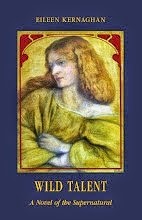
Wild Talent is available again on amazon.com
.
I'm happy to say that after a long hiatus, my historical fantasy novel Wild Talent: a Novel of the Supernatural, set in the London and Paris of 1888 and 1889, is once again available on amazon.com.
 Here, speaking for themselves, are some of the historical figures who appear in its pages:


It was not yet light when I crept out of the house, and I dared not take any food from the larder for fear of waking my aunt and uncle; and so as I made my way in the chill grey dawn toward Berwick I was hungry and thirsty and my spirits very low. But as I came near Berwick I could hear the dawn chorus of the birds, and then the sun rose. From the fields all around came the fragrance of dew-soaked grass, and in the hedgerows the hawthorn was in bloom. I was sorry, then, that I must leave. But I thought, however drab and grey the city may prove to be, and whatever misadventures may await me there, I cannot stay in a place where they think me at best a witch, at worst a murderess. And I remembered how Father used to say that opportunity could grow out of mischance, so as I trudged towards Berwick station I imagined the oak desk, the sunny room, the shelves of books with my name in gilt; and I began to walk faster, with a lighter heart.
So here I sit, on the morning train to London, with my journal on my lap. The woman beside me stared when I sat down, and I know how bedraggled I must look, with my hem all smirched and my boots muddy where I cut across the fields.
But now we have crossed the great viaduct, the Royal Border Bridge, that spans the Tweed from Berwick to Tweedmouth, and the train is gathering speed, hurtling into England. Stone walls and lonely farms and flocks of black-faced sheep all rush by, and on the other side is the sea, the Holy Isle of Lindisfarne, and the twin castles facing each other across the bay. Soon we will be in Newcastle, with the Borders and my old life forever behind me. I mean to keep a careful record of this journey, writ plain and in proper English, as a novelist would; for when I come to write the story of my life, this will be the opening chapter.
I must not think any more about George. It was a wicked thing I did, whether I meant it or not, and it is a shame I must live with. But more wicked than the act itself, I realize now, was the guilty joy I felt as my weapon found its mark.
I'm happy to say that after a long hiatus, my historical fantasy novel Wild Talent: a Novel of the Supernatural, set in the London and Paris of 1888 and 1889, is once again available on amazon.com.
 Here, speaking for themselves, are some of the historical figures who appear in its pages:
Adventure is my only reason for living.
-- Alexandra David-Néel
To pursue the mysteries on our earth is not without danger, but how much greater the risk incurred by those whose imagination incites them to wander in those domains they believe are situated beyond our normal frontiers. -- Alexandra David-Néel, Le sortilège du mystère

…I am but the reflection of an unknown bright light… I cannot help myself that all these ideas have come into my brain, into the depth of my soul; I am sincere although perhaps I am wrong.
--Madame Helena Petrovna Blavatsky


And Jeannie Guthrie's adventure begins:
It was not yet light when I crept out of the house, and I dared not take any food from the larder for fear of waking my aunt and uncle; and so as I made my way in the chill grey dawn toward Berwick I was hungry and thirsty and my spirits very low. But as I came near Berwick I could hear the dawn chorus of the birds, and then the sun rose. From the fields all around came the fragrance of dew-soaked grass, and in the hedgerows the hawthorn was in bloom. I was sorry, then, that I must leave. But I thought, however drab and grey the city may prove to be, and whatever misadventures may await me there, I cannot stay in a place where they think me at best a witch, at worst a murderess. And I remembered how Father used to say that opportunity could grow out of mischance, so as I trudged towards Berwick station I imagined the oak desk, the sunny room, the shelves of books with my name in gilt; and I began to walk faster, with a lighter heart.
So here I sit, on the morning train to London, with my journal on my lap. The woman beside me stared when I sat down, and I know how bedraggled I must look, with my hem all smirched and my boots muddy where I cut across the fields.
But now we have crossed the great viaduct, the Royal Border Bridge, that spans the Tweed from Berwick to Tweedmouth, and the train is gathering speed, hurtling into England. Stone walls and lonely farms and flocks of black-faced sheep all rush by, and on the other side is the sea, the Holy Isle of Lindisfarne, and the twin castles facing each other across the bay. Soon we will be in Newcastle, with the Borders and my old life forever behind me. I mean to keep a careful record of this journey, writ plain and in proper English, as a novelist would; for when I come to write the story of my life, this will be the opening chapter.
I must not think any more about George. It was a wicked thing I did, whether I meant it or not, and it is a shame I must live with. But more wicked than the act itself, I realize now, was the guilty joy I felt as my weapon found its mark.
Wednesday, November 16, 2011
Who really wrote Shakespeare's plays? The argument continues.
 |
| Lady Mary Sidney Herbert |
The release of the film Anonymous has revived the enduring question of who really authored Shakespeare’s plays. Was it Ben Jonson, Christopher Marlowe, the Earl of Derby, the Earl of Rutland, the Earl of Southampton, the Earl of Essex, Sir Walter Raleigh, Francis Bacon -- or as the movie would have it, Edward de Vere, Earl of Oxford (a theory most reviewers call Blackadderly).
Personally, in spite of the arguments to the contrary, I’d like to believe that the Bard of Avon was responsible for his own plays. (Well, okay, maybe not Titus Andronicus.) But if there is a serious contender for secret authorship, my money would be on Lady Mary Sidney Herbert, Countess of Pembroke. The sister of Sir Philip Sidney, and one of the most gifted and prolific women writers of the Renaissance, she was the first woman to publish a play in English, and was generally acknowledged as the second most intelligent woman in England. (First place of course went to Lady Mary’s friend Elizabeth I ) At her family estate, Wilton House, near Glastonbury, Lady Mary hosted a famous literary salon, “The Wilton Circle”, attended by most of the well known writers and musicians of the age. Among her guests were Edmund Spenser, Michael Drayton, Sir John Davies, and a promising young poet, Will Shakespeare of Warwickshire.
Apart from her accomplishments as writer, editor and translator, Lady Mary had a keen interest in medicine and alchemy (she had her own alchemical laboratory at Wilton House) and she pursued such esoteric interests as secret musical codes, spiritual magic and invisible ink.
Recognizing a promising young talent, she may well have served as Shakespeare’s mentor. But did she have a hand in writing Will’s plays? Her background and education, her many fields of expertise and her writing talent all lend credibility; but until we discover some Shakespeare-attributed work in Lady Mary’s handwriting, the jury will have to remain out.
Lady Mary and her Wilton House colleagues make an appearance in my 2004 historical fantasy, The Alchemist’s Daughter. (The book is currently sold out at the publishers, but you can find it in better online used bookstores)
Tuesday, November 8, 2011
November 11th, 1994

after the laying of wreaths, the Legion fills.
Between sobriety and bathos comes
a quiet stage of drunkenness when men
remember private wounds -- lost youth,
illusion, hope -- when chinks grow wide
in the high walls they hide behind, the walls
that women never learn to build.
A man turns to an old comrade, then,
and says, "I was glad to have you at my back.
You were quiet, but you were a good man."
"We were all good men," the other says,
and something suddenly is laid bare
that cannot be explained, or shared.
(From Quintet: Themes & Variations, Ekstasis Press 1998)
Monday, October 10, 2011

Wednesday, October 5, 2011
Casey Wolf reads from Winter on the Plain of Ghosts

Drop into the multi-talented Casey Wolf's Wolfden blogsite and listen to Casey reading an excerpt from my historical fantasy Winter on the Plain of Ghosts: a Novel of Mohenjo-daro . The Winter on the Plain of Ghosts excerpt is also available on you-tube .
Wednesday, August 24, 2011
Through the Window of the Garden Shed

"Through the Window of the Garden Shed" from Tales from the Holograph Woods: Speculative Poems, read at Poetic Justice, New Westminster BC, August 21, 2011.
Sunday, June 12, 2011
Small press vs big press
.
On the latest posting for her "Writer in Residence" blog, Krista D. Ball asks me, "Why did you go small press?" You can read the whole interview here.
From Krista's blogsite, "Writer in Residence was started by Krista D. Ball, after having a bit of a fit over the lack of sensible, correct, and experience-based guidance out there for new writers. Writer in Residence will feature theme months and guest posts, all to offer real-life experiences from the writing and publishing worlds." Do pay Krista and her guest bloggers a visit -- and she welcomes comments.
Saturday, May 28, 2011
Atalanta

A boar suckled me.
Hunters reared me.
I am not as other women.
My limbs are fashioned of wind,
my feet are flame-shod.
I have strong arms to stretch the bowstring,
a heedless mouth that laughs across my shoulder
as one by one my doomed suitors
fall behind me
exhausted in the dust.
I am a thrown spear.
I am an arrow shot from the bow.
I am death's handmaiden
whom no man outruns.
But Melanion, with your smile as innocent as orchards,
you do not come wooing empty handed.
You fling before me Aphrodite's
treacherous golden apples
burning like small suns in the white dust,
so ripe, so round that my palms itch for them
and each one a leaden plumb-weight
to hold me to the ground.
First published in Isis Rising, 2000
Photo © Marie-Lan Nguyen / Wikimedia Commons
Monday, May 23, 2011
Asterion
.

At my birth, they say, the midwife
fainted at the sight of me.
Sweet mother, Pasiphaë, when you crouched
in the hot dust waiting for the white bull
to part your welcoming thighs, did you dream
then, what monster might be spawned
from your improbable lust?
Asking nothing, I have accepted what was given—
not human enough to spare the lives men sent me,
nor beast enough to remember them without shame.
If I did not exist, it would be necessary to invent me.
Mother. Stepfather. Sister. All who should have loved me
have betrayed me. Only Theseus has been faithful
to the destiny that binds us close as brothers.
Tonight I hear the echo of his footfall through the labyrinth.
I roar his name.
The thread unwinds.
First published in Paradox: The Magazine of Historical and Speculative Fiction, Issue #10, 2006.
Friday, May 13, 2011
Living in the Past, Part 3

HISTORICAL FANTASY FOR THE CLASSROOM
a sampling
Prehistory
Jean Auel, Clan of the Cave Bear YA to adult
Eileen Kernaghan, The Sarsen Witch (Bronze Age Britain) YA to adult
Joanne Findon, When Night Eats the Moon (Iron Age Britain) 9-12
Mesopotamia/ Sumeria
Geraldine McCaughrean, Gilgamesh the Hero. ages 9-12
Ludmila Zeman, Gilgamesh trilogy (Gilgamesh the King; Revenge of Ishtar; The Last Quest of Gilgamesh) Ages 9-12.
Egypt
Jane Lindskold, The Buried Pyramid. YA
Judith Tarr, Lord of Two Lands. YA. to adult
Indus Valley
Eileen Kernaghan, Winter on the Plain of Ghosts: a novel of Mohenjo-daro (Older YA to adult)
Ancient China
Wei Jiang, Legend of Mu Lan: A Heroine of Ancient China
Lloyd Alexander, Dream-of-Jade, the Emperor’s Cat. age 9-12
Ancient Greece
Robert Byrd, The Hero and the Minotaur. Gr. 3-6
Dave Duncan (writing as Sarah B. Franklin) Daughter of Troy. Older YA.
Mary Renault, The King Must Die and The Bull from the Sea (older YA to adult)
Patrice Kindl, Lost in the Labyrinth Ages 10 to 14
Caroline B. Coney, Goddess of Yesterday YA
Rome and Roman Britain
Alan Garner, Red Shift. YA (Time- Slip novel set in Roman Britain,
17th C. England and modern times) YA
17th C. England and modern times) YA
Judith Tarr and Harry Turtledove, Household Gods. (Older YA to adult)
Vikings
Madeleine A. Polland, Beorn the Proud . Age 4-8
Chris Humphreys, The Fetch. YA
J.B. Olofsen, Svipdag YA
Middle Ages
Janet McNaughton, An Earthly Knight (12th Century Scotland) YA
Simon Rose, The Sorcerer’s Letterbox and The Heretic’s Tomb. (Mediaeval England) Gr. 4 to 7
Connie Willis, The Domesday Book (the Plague Years in England) YA to adult
Elizabethan England. Susan Cooper, King of Shadows
Susan Price, The Sterkarm Handshake
Eileen Kernaghan, The Alchemist’s Daughter YA
Early explorations
Russel Freedman, author, Bagram Ibatouline, Editor, Adventures Of Marco Polo .
Ages 9-12 (Whether or not some of Marco Polo’s adventures were actually fantasy, the exotic splendour of Kublai Khan’s court lends its own enchantment)
Ages 9-12 (Whether or not some of Marco Polo’s adventures were actually fantasy, the exotic splendour of Kublai Khan’s court lends its own enchantment)
Renaissance Italy
Gregory Maguire, Mirror, Mirror. YA to adult
Dave Duncan, The Alchemist’s Apprentice. YA to adult.
Seventeenth Century England
John Wilson. The Alchemist’s Dream * 9-12 (not a fantasy per se,
but the presence of Dr. John Dee adds a touch of magic.)
but the presence of Dr. John Dee adds a touch of magic.)
Himalayan Kingdoms
Peter Dickinson, Tulku
Eileen Kernaghan, Dance of the Snow Dragon (18th century Bhutan) YA
Victorian England
Linda Newberry, Set in Stone (Gothic YA)
19th century Ireland
James Heneghan, The Grave YA
Roberta A. McAvoy, The Grey Horse. YA to adult
Historical Canada
Kit Pearson, A Handful of Time
Julie Lawson, White Jade Tiger
Janet Lunn,. The Root Cellar
First Nations
Louise Erdrich, The Birchbark House
Comments are invited: add your own favourite titles!
Comments are invited: add your own favourite titles!
Saturday, April 30, 2011
Demeter and Persephone Celebrate Spring in the British Museum
.

Why did I think they would be sedate,
serene...
serene...
cool Parian goddesses reigning over
the still white halls of high culture?
the still white halls of high culture?
They are Greeks, after all,
these boisterous, blowzy, bumptious women.
Two centuries of British damp have not extinguished
their Mediterranean fire.
This one is Demeter,
broad hips firmly planted,
these boisterous, blowzy, bumptious women.
Two centuries of British damp have not extinguished
their Mediterranean fire.
This one is Demeter,
broad hips firmly planted,
strong peasant thighs indecorously
splayed. Beside her, first-born and beloved,
Persephone-- no shy bride now,
splayed. Beside her, first-born and beloved,
Persephone-- no shy bride now,
but queen in her own right,
at ease, expansive,
at ease, expansive,
summoning the harrassed Hebe
with an upflung arm.
Soul-sisters, comrades,
carved from a single block of marble,
with an upflung arm.
Soul-sisters, comrades,
carved from a single block of marble,
we see them forever frozen
in that first drunken and ecstatic instant
when the only season that follows spring is summer--
when winter and death are things that happen
in another country.
in that first drunken and ecstatic instant
when the only season that follows spring is summer--
when winter and death are things that happen
Tuesday, April 26, 2011

Sunday, April 24, 2011
Alice, in a gilt frame, with rabbits

Wistful Alice in your green Victorian wood,
perhaps the artist knows
what you have yet to learn,
what you have yet to learn,
that a dark, disordered country
waits outside the glass --
a world of whimsical justice
wielded by mad queens,
and white knights who mean well
but cannot be relied upon.
Wednesday, March 30, 2011
A Biblical Bestiary #1
.
... blind guides, which strain at a gnat,
... blind guides, which strain at a gnat,
 |
| Sebastian Munster, Cosmographia |
-- St. Matthew 23:24
In Arabia Felix this is the season
when the camels swarm:
huge hummocky windborne
packages of hair and dangling legs and spit
blundering like busses through the ochre air.
The wise traveller, knowing better than to speak
or yawn, will make his way across the sand
in silence.
Monday, March 28, 2011
Celebrating National Poetry Month
green silk
shaken out to air on hedgerows
. . . another April
 |
| Woodcut: The Works of Edmund Spenser, Volume I (1930) |
Tuesday, January 25, 2011
Wild Talent reviewed by the Historical Novel Review

An excellent review of Wild Talent: a Novel of the Supernatural has just been posted at The Historical Novel Review blog. Mirella Patzer writes "Although this novel is listed as a young adult novel, it transcends this limitation easily into adult or women's fiction. It is richly written with a high regard for historical detail, making this novel a true and accurate journey into the richness of the Victorian world." Here's a link to the full review.
Tuesday, December 14, 2010
Wintry Tales

December 31, 1887
Tonight, in these last hours of the old year, I have been thinking of New Year's Eves at home in the Borders, when I was a child and my father still alive. I remember how the Hogmanay fires burned the old year out, how the midnight bells rang, and how we waited for a dark-haired man to step over our threshold, bearing gifts of coal and salt, black buns and shortbread.
I wonder what they do to welcome the New Year in that great house (as I imagine it) in Wiltshire. Are there bonfires on the downs, and bells pealing out? Perhaps Tom Grenville-Smith is alone tonight, as I am, sitting beside the fire with a book on his knee while he dreams about Brazil. But no, most likely there will be a ball, and it will be waltz music that he hears; and he will dance with ladies in low-cut Paris gowns in a blaze of lamplight, under glittering chandeliers.
These winter nights when I am abed with the candle blown out and I am drifting towards sleep, I find myself thinking how it would be to leave this cold grey city and live once again among woods and fields: not in a ploughman's cottage as I once did, but in a grand house with servants and many rooms, and one room entirely to myself, with shelves for my books and a desk upon which to write. And sometimes as sleep overtakes me, though I know it is daft to do so, I think of the one person with whom I would wish to share that house -- or any house, be it only a ploughman's cottage after all. (From Wild Talent: a Novel of the Supernatural)
* * *
The moon came out, and flooded the broken snowscape with its chill white light. Never had Gerda imagined a scene so beautiful, or so forbidding. There was something dreamlike, hallucinatory, about this northward journey. Always before there had been lakes and rivers, hills and forests to help them chart their way. Now there were no more landmarks, and the thin shell of ice upon which they walked was like a vast unfinished puzzle, the pieces endlessly lifted and turned and shuffled by a giant hand.
Gerda had not thought it was possible to be so lonely. Though she was grateful for Ritva's steadfast presence, each of them, trudging silently through that frozen world, was locked in her own solitude. Is there anything more frightening, Gerda mused, than to be utterly alone with one's own thoughts? It was no wonder that arctic travellers panicked and went mad.
*
 "Oh, look," said Gerda, awestruck, as the black sky filled with swirling ribbons and darting, flickering shafts of rainbow colour. "Ritva, look, the northern lights!"
"I see them, " said Ritva impatiently. She added, with sour irony, "Why are you whispering? Who's going to hear you?" And Gerda realized that her voice was as hushed as if she were in church.
Somewhere in the near distance there was a thunderous crash; the ice shuddered and rocked beneath their feet. Ritva caught hold of Ba's collar as he reared in panic. In the shimmering light of the aurora they saw a huge crack opening up not twenty paces ahead.
An ice-block the size of a cottage thrust halfway out of the fissure, and then slipped back. There was a grinding, splintering sound, and with a jolt the ice tilted sharply beneath them. Suddenly everything seemed to be moving, shifting, eddying. It was as though some huge sea-creature was threshing wildly beneath the ice.
Gerda's heart gave a sick lurch as she watched a black, windbroken expanse of water widening before them. Ever since they had abandoned the Cecilie this was the thing she had dreaded most, the fear that had haunted her restless sleep. They were adrift, at the mercy of wind and tide, on an ice-floe hardly bigger than the Princess's swansdown bed. ( From The Snow Queen)
* * *
All at once the wind died, and the sky cleared, and they were climbing through a jewelled world, transfigured by the evening sun. Every cliff and crag glittered with icicles, topaz and emerald in the slanting light. Ice crunched and splintered beneath their feet. Sangay looked down and saw that the path was striped with shimmering bands of colour -- pale green, white, sapphire blue and ruby-red. They had come to a curtain of ice, suspended like a frozen cataract across the trail. Sangay put up his hands to shield his eyes from the glare of the reflected sun.
Then somehow, in a dazzle of light, they had passed through and beyond the ice-curtain, into a forest of spires and turrets and columns. The air was very cold, very still, and filled with an eerie ghost-green radiance. Sangay could hear only the crackle of the ice under his boots, and the faint whistling of his own lungs. His breath hung before him like pale green smoke.
Now, as Jatsang led him deeper and deeper into the heart of the glacier, the path widened, and there were glistening open spaces among the thrusting ice-spires. The cold green light brightened, was edged with gold like the first flush of sunrise seeping into the sky. And then they had passed beyond the frozen forest and its shrouding wall of ice, and had come to the edge of a summer garden, a green and flowering valley hidden away among the snow-bound peaks. (fom The Dance of the Snow Dragon)
 ICE SONGS
Prayer flags dance in a white dawn.
The wind’s horses leave no track upon the snow.
The voice of the flute
is the sound of a white bird singing.
Night music: beating of white wings
Over frozen water.
Under the ice, moon-bubbles rise.
The fish are dreaming.
(From Tales from the Holograph Woods: Speculative Poems)
Friday, November 12, 2010
Banff Centre production of The Snow Queen comes to Vancouver
 “Mix snow, ice, enchanted mirrors, and reindeer, add a string quartet and narrator, and the stage is set for a magical retelling of a classic Hans Christian Andersen tale." In 2007 Canadian composer Patrick Cardy’s adapted score of The Snow Queen for string quartet and narrator achieved the grand vision of the late composer in a spectacular new production created at The Banff Centre.
"The Snow Queen tells a story of friendship through adversity and of a brave journey guided by courage and love. Working with the Centre’s Music and Sound, Theatre Arts, and Creative Electronic Environment departments, Canadian actor Alon Nashman and the Toronto-based Tokai String Quartet participated in a two-week residency at the Centre, enabling The Snow Queen to be realized for the first time as a full theatrical production incorporating image projection, lighting design, and audio support.”
 This multi-media family production of the The Snow Queen comes to Vancouver's Round House Community Arts and Recreation Centre, February 24-26 2011 . It features the Cecilia Quartet, winners of the 2010 Banff International String Quartet Competition. For more information see the Music in the Morning website.
For more on Andersen's The Snow Queen, and my YA novel based on the story, see my June 13, 2007 posting on this blog: Wild women, robber-maids and travelling ladies )
Wednesday, October 27, 2010
Bondagers
 From the Author’s Note to Wild Talent: A Novel of the Supernatural: On the farms of the Scottish Borders in the 19th century, field workers were mostly women and young girls. Hired or “bonded” at hiring fairs along with a male relative, they were known as bondagers, and they did every kind of heavy outdoor work except for ploughing.
I first encountered a reference to bondagers in a coffee table book on English cottages: “In Northumberland there was a large class of female farm workers, known as bondagers, who were the servants of the hind, who in turn was the farmer’s servant. The bondagers were always unmarried,, aged between ten and thirty, and they would live in. On the larger farms there might be six or eight hinds, each with two or three bondagers to help him. They would work in gangs, chiefly out of doors, but if there was little to do on the land, bondagers were not bound, like other women to take on trivial household tasks.” (English Cottages, by Tony Evans and Candida Lycett Green, Penguin Books, 1982, p.16)
Intrigued, I wondered if the lives of these women workers had ever been documented. With a little research I discovered that the term “bondager” had been in use right up until the beginning of the Second World War for full-time women field workers in the south-east of Scotland. I also learned that in 1997-98 the Scottish Working People’s History Trust had recorded the personal recollections of eight Scottish bondagers , who were then in their eighties and nineties These oral histories, transcribed in the women’s own words, were edited by Ian MacDougall and published in 2000 by Tuckwell Press as Bondagers: Eight Scots Women Farm Workers.
The book begins with an interview with Mary King, born 1905 in Berwickshire.
“Well, ah can remember the first day I went out ah felt a bloomin’ fool because ah wis dressed we’ this big straw hat and the drugget skirt and the brat, because ah wis supposed to be a bondager. There wis an older woman, ee see, and ah wis dressed the same as her. And ah remember her takin’ me tae the granary, up the stair, and writin’ ma name and ma age an ma weight. And ah was 7 stone 12. And ah wis only thirteen years auld. And that’s what ah was.”
Scottish playwright Sue Glover brought the lives of the bondagers to the stage in her 1991 play Bondagers: a play in two acts for six women.
And in my novel Wild Talent, Jeannie Guthrie writes in her journal:
"Today I was up at 5:30, with cold mist curling over the fields, to be at the stables by first light. The steward set me to work sorting tatties for the spring planting: six in the morning till six at night stooped over the pit in a grey drizzle, up to my boot-tops in mud, my hands half-frozen in my gloves. And on this day -- though it has passed as drearily as the ones before and the ones to follow -- I am sixteen years old.
. . . That raw February morning when I went with my Uncle James to the hiring fair, I guessed well enough what my life was to become. I was not yet fourteen, shivering with cold and nerves in my thin jacket, while the farmers came by to ask my uncle "Are ye to hire? And do you have a woman or girl with you?" Other women were laughing and chattering, in a holiday mood, for they'd not have a free day again before New Year's. And there was I, near dying of shame while the farmers looked me up and down, and my uncle swearing I was a braw strong girl, with back and arms meant for stooking sheaves and cleaning byres. No Paris gowns it was to be, for Jeannie Guthrie, but an apron and drugget skirt. No feathered chapeau, but a bondager's kerchief and wide straw hat ruched with red and black; no stockings of silk, but rough tweed leggings and tackety lace-up boots.
More on bondagers
Thursday, September 23, 2010
By the Pond at Liu Pei T'ing *


Slow rain falls on hollow stone;
your lute lies silent on the bench.
Wind stirs the open pages
of your book.
The wine is gone.
My cup floats on the green curve of the canal.
Before it finishes its small journey
I must write this poem.
* The Pavilion of Floating Cups
From Tales From the Holograph Woods:
Speculative poems
Speculative poems
Wattle & Daub Books 2009
Subscribe to:
Posts (Atom)